
The best Afterpay alternatives in 2026 are Affirm for larger purchases, PayPal Pay in 4 for interest-free plans with no late fees, and Klarna for shopping at stores that don’t offer Afterpay. “Interest-free” doesn’t always mean fee-free, so the total you repay matters more than the size of each installment.
Most shoppers leave Afterpay for one of three reasons:
- Afterpay isn’t accepted at the store they want to use, online or in person.
- Afterpay’s six-week Pay in 4 schedule is too short for a big purchase, and Afterpay’s monthly plans stop at 24 months.
- Afterpay’s late fee of up to $8 per missed installment feels like a risk they’d rather avoid.
This guide ranks seven alternatives on six weighted criteria and uses Afterpay’s own published terms as the unranked baseline. Every fee and limit below was checked in November 2026.
Tested SaaS has no affiliate relationships with any company listed. Rankings are determined entirely by research data and objective evaluation criteria.
What Are the 6 Categories of Afterpay Alternatives?
Afterpay alternatives fall into six categories based on how they lend money and where they work. The categories range from long-term lenders like Affirm to paycheck-linked marketplaces like Perpay. A provider’s category tells you more about cost, store reach and credit impact than its brand name does, so pick a category first.
- Long-Term Financing Lender (short label: Lender): Affirm offers pay-in-4 plus monthly installment loans for larger purchases.
- Wallet-Embedded Pay Later (short label: Wallet): PayPal Pay in 4 and PayPal Pay Monthly build installment plans into an existing digital-wallet checkout.
- Shop-Anywhere BNPL App (short label: Anywhere): Klarna and Zip issue virtual cards so installments work beyond partner checkouts.
- Merchant-Checkout Pay-in-4 (short label: Checkout): Sezzle offers short-term installments mainly at partner merchants’ checkouts.
- Card-Linked Installments (short label: Card-Linked): Splitit splits a purchase into installments on a credit card the shopper already owns.
- Paycheck-Linked Marketplace (short label: Marketplace): Perpay runs a closed shopping marketplace that is repaid through automatic paycheck deductions.
How Do the Top Afterpay Alternatives Compare at a Glance?
Affirm ranks first overall with a weighted score of 4.20 out of 5. PayPal Pay in 4 / Pay Monthly follows at 3.98 and Klarna at 3.73. Each provider wins a different situation. Affirm suits large purchases, PayPal suits no-late-fee short-term plans, and Klarna and Zip tie for the widest store reach. Afterpay appears in the last row as the unranked baseline.
| Rank | Company | Category | Best For | One-Line Summary | Key Capabilities | Primary Strength | Key Limitation |
|---|---|---|---|---|---|---|---|
| 1 | Affirm | Lender | Purchases up to $30,000 | Affirm is the strongest Afterpay alternative for larger purchases because it offers loans up to $30,000 over as long as 60 months with no late fees and simple interest. | Pay in 4, 3–60-month loans, Affirm Card, virtual cards | No late fees and simple interest | APR up to 36% |
| 2 | PayPal Pay in 4 / Pay Monthly | Wallet | No late fees at PayPal stores | PayPal Pay in 4 is the most predictable short-term Afterpay alternative because it charges 0% APR and no late fees on eligible purchases where PayPal is accepted. | Pay in 4, Pay Monthly up to $10,000, no separate app | 0% APR and $0 late fees on Pay in 4 | Works only where PayPal is accepted; its own pages give conflicting terms |
| 3 | Klarna | Anywhere | Shopping at more stores | Klarna is tied with Zip for the widest store reach among the alternatives evaluated, combining a one-time virtual card with Pay in 4, Pay in 30 days and financing in one app. | One-time virtual card, Pay in 4, Pay in 30, financing, Klarna Card | Virtual card for stores without a Klarna checkout | Late fee up to $7; Pay in 4 reportedly not reported to U.S. bureaus |
| 4 | Splitit | Card-Linked | Credit card holders | Splitit is the only ranked Afterpay alternative that runs no credit check of its own and charges no Splitit fees, because it splits purchases on a credit card the shopper already owns. | Installments on an existing card, no new loan | $0 Splitit interest and fees | Needs the full amount available on a credit card; few merchants |
| 5 | Zip (formerly Quadpay) | Anywhere | BNPL at almost any store | Zip is tied with Klarna for the widest store reach among the alternatives evaluated, but Zip’s origination fees can equal about 35% APR on its own published examples. | Virtual card via Apple Pay or Google Pay, Pay in 2, 4 and 8 | Works online and in physical stores | Fees equal to about 35% APR in Zip’s examples |
| 6 | Sezzle | Checkout | Credit building at partner stores | Sezzle is an Afterpay alternative with no hard credit check and an optional credit-building feature, but Sezzle’s fee schedule is the most complex of the seven alternatives Tested SaaS evaluated. | Pay in 4, Sezzle Up, Sezzle Anywhere, Premium | Sezzle Up credit-building feature | Late fee up to $16.95; many fee types |
| 7 | Perpay | Marketplace | Thin credit with steady payroll | Perpay is the Afterpay alternative for shoppers with limited credit and steady payroll income, offering no hard credit check, but Perpay can only be used in its own marketplace. | Paycheck-repaid marketplace, Perpay+ credit reporting | No hard check, no marketplace interest or late fees | Closed marketplace with reported price markups |
| Baseline (not ranked) | Afterpay | Checkout | Shoppers whose stores accept Afterpay | Afterpay is the baseline: 0% interest on Pay in 4, a late fee of up to $8, and monthly plans of up to 24 months. | Pay in 4, monthly plans of 3–24 months | Simple interest-free Pay in 4 | Limited acceptance and late fees, per G2 reviewers |
Which Afterpay Alternative Should I Choose for My Use Case?
Choose an Afterpay alternative by the one thing that matters most to you, not by overall rank. The table below matches eight common priorities to a recommended provider and a backup, so you can go straight to the entry that fits.
| Your #1 Priority | Recommended Tool | Why | Acceptable Alternative |
|---|---|---|---|
| Financing a larger purchase over months | Affirm | Loans up to $30,000 over up to 60 months, with no late fees | PayPal Pay Monthly (up to $10,000, up to 24 months) |
| No late fees on a pay-in-4-size purchase | PayPal Pay in 4 | 0% APR and $0 late fees | Affirm Pay in 4 |
| Using BNPL at a store without Afterpay | Klarna | One-time virtual card for stores without a Klarna checkout | Zip |
| Everyday in-store BNPL through a phone wallet | Zip | Virtual card works through Apple Pay or Google Pay | Klarna |
| No credit check, and you own a credit card | Splitit | No new loan and no Splitit credit check | Perpay (if you have payroll direct deposit) |
| No hard check, thin credit, steady payroll | Perpay | Approval based on payroll; no marketplace interest or late fees | Sezzle (no hard check) |
| Gig or 1099 income (no payroll direct deposit) | Klarna or Zip | Neither requires payroll direct deposit | Splitit (if you hold a credit card) |
| Building credit with BNPL | Affirm | Reports to Experian and TransUnion | Sezzle Up or Perpay+ |
Perpay requires payroll direct deposit, so shoppers paid through gig or 1099 work should use the gig-income row instead.
1. Affirm: Best Overall for Larger Purchases
Category: Long-Term Financing Lender, offers pay-in-4 plus multi-month installment loans for larger purchases.
At a Glance
- Category: Long-Term Financing Lender
- Best For: Shoppers financing purchases too large for a six-week pay-in-4 plan, up to $30,000
- Price Range: 0%–36% APR depending on borrower, merchant and plan; $0 late, annual and prepayment fees (terms checked November 2026)
- Primary Strength: Affirm offers 3–60-month loans on purchases up to $30,000 with no late fees and simple, non-compounding interest.
- Biggest Limitation: Affirm’s monthly plans can carry APRs up to 36%, so a long interest-bearing plan can cost more in total than an interest-free pay-in-4 plan.
- One-Line Summary: Affirm is the strongest Afterpay alternative for larger purchases because it offers loans up to $30,000 over as long as 60 months with no late fees and simple interest.
- Last Verified: November 2026
Overview
Affirm is a U.S. buy now, pay later lender that offers Pay in 4 and monthly loans of 3 to 60 months on purchases up to $30,000. It is built for shoppers who need more time than Afterpay’s six-week Pay in 4 schedule allows. Affirm charges no late fees, but its APR depends on the borrower, merchant and plan.
Affirm earned the highest weighted score in this evaluation, 4.20 out of 5. Affirm’s highest marks were 5.0 on purchase size and 5.0 on scale. Its lowest was 3.0 on user sentiment, because its BNPL product has no verified consumer review-platform rating.
Key Features
- Affirm offers Pay in 4 at 0% APR for eligible shoppers alongside monthly installment loans of 3 to 60 months.
- Affirm finances purchases up to $30,000, the highest ceiling among the alternatives evaluated.
- Affirm charges no late fees, annual fees or prepayment fees, and Affirm’s interest is simple rather than compounding.
- Affirm provides the Affirm Card, virtual cards and a mobile app for paying outside its own checkout integrations. Affirm also powers Shop Pay Installments at participating Shopify checkouts; Shop Pay’s own terms weren’t reviewed.
- Affirm uses a soft credit inquiry to check eligibility and reports loans to Experian and TransUnion.
Best For
Affirm is best for shoppers buying high-ticket items who need a year or more to repay, especially buyers who qualify for a merchant-funded 0% offer.
Pricing
Affirm’s APR ranges from 0% to 36% depending on the borrower, merchant and plan. Affirm charges no late, annual or prepayment fees (Affirm investor materials, terms checked November 2026).
- Affirm’s 0% offers are usually paid for by the merchant. One Reddit user who got a 0% loan on a $15,000 watch noted that “the merchant pays Affirm a small fee” (u/restatementtorts, r/personalfinance, 2026).
- Illustrative arithmetic, not a quoted Affirm offer: a $2,000 purchase repaid over 12 months costs $2,000 at 0% APR and about $2,411 at 36% APR with simple interest. The extra $411 equals about 51 of Afterpay’s maximum $8 late fees.
Strengths
- Affirm reported $50.2 billion in GMV, $4.261 billion in revenue, 27.8 million active consumers and 570,800 active merchants for fiscal 2026, which ended June 30, 2026 (Affirm FY2026 shareholder letter, 2026).
- Affirm reported 5.2 million active Affirm Card holders and $2.842 billion in Affirm Card GMV in Q4 fiscal 2026, which shows the card is widely used outside Affirm’s merchant checkouts (Affirm FY2026 earnings supplement, 2026).
- Affirm offers terms of up to 60 months on purchases up to $30,000, while Afterpay’s monthly plans stop at 24 months (NerdWallet, 2026; Afterpay loan agreement, 2026).
- Affirm reports loans to Experian and TransUnion and has reported Pay in 4 loans to Experian since April 1, 2025, so on-time payments are on record with the bureaus (NerdWallet, 2026; Congressional Research Service, 2025).
Limitations
Affirm’s biggest trade-off is that it replaces late fees with interest. Its monthly plans can reach 36% APR. A long plan without a 0% promotion can cost far more than Afterpay’s interest-free Pay in 4, even if every payment is on time.
- Affirm makes an approval decision for each purchase, and shoppers report declines and lower-than-expected offers (NerdWallet, 2026; CBS News, 2025).
- Affirm’s bureau reporting means a missed Affirm payment can be visible to lenders who use Experian or TransUnion data.
- Affirm has no verified consumer review-platform rating for its BNPL product. Reddit reports are mixed: one user financed a guitar and “ultimately paid no interest” (u/0xF00DBABE, r/personalfinance, 2026).
- Affirm was described by another Reddit user as charging heavy fees. That report conflicts with Affirm’s published no-late-fee policy and couldn’t be verified (u/glittereddaisy13, r/Sezzle, 2026).
Users on r/Affirm shared their experience:
“Yes it says I have purchased power at stores but then I can’t use it, my purchasing power is tied up in plans is what the rep told me which is crazy cause I only have two loans out when I had six out at one time I just paid them off last month and never been late or missed a payment so I don’t understand what is going on, they told me to try again on May 12th, smh.” Posted by u/WayFun6540
Takeaway: Affirm’s displayed purchasing power isn’t a guarantee: even customers with spotless payment histories say they’ve been blocked from using the limits shown in the app.
How It Compares With Afterpay
- Affirm runs longer than Afterpay, up to 60 months versus Afterpay’s 24-month maximum, and finances purchases up to $30,000.
- Affirm charges no late fees, while Afterpay charges up to $8 per late installment.
- Afterpay’s Pay in 4 remains the simpler interest-free choice for small purchases at stores that accept Afterpay.
Verdict
Affirm is the best overall Afterpay alternative in 2026 for shoppers financing larger purchases, because it combines terms of up to 60 months, a $30,000 ceiling and no late fees.
Affirm’s simple-interest model is easier to predict than deferred-interest financing. Still, a 36% APR plan adds about $411 to an illustrative $2,000, 12-month purchase. For small purchases that fit four payments, PayPal Pay in 4 is more predictable.
2. PayPal Pay in 4 / Pay Monthly: Best for No Late Fees
Category: Wallet-Embedded Pay Later, installment plans built into a digital wallet’s existing checkout.
At a Glance
- Category: Wallet-Embedded Pay Later
- Best For: Shoppers at stores that accept PayPal who want interest-free pay-in-4 with no late fees
- Price Range: Pay in 4: 0% APR, $0 late fees; Pay Monthly: up to 35.99% APR, $0 late and sign-up fees (terms checked November 2026)
- Primary Strength: PayPal Pay in 4 charges no interest and no late fees, so the total repayment equals the purchase price.
- Biggest Limitation: PayPal Pay in 4 works only where PayPal checkout is offered, and PayPal’s own pages publish conflicting purchase ranges and APR floors.
- One-Line Summary: PayPal Pay in 4 is the most predictable short-term Afterpay alternative because it charges 0% APR and no late fees on eligible purchases where PayPal is accepted.
- Last Verified: November 2026
Overview
PayPal Pay in 4 and PayPal Pay Monthly are installment options built into PayPal checkout. They offer four interest-free biweekly payments or plans of 3 to 24 months, for shoppers who already use PayPal and want no late fees. Neither plan needs a separate BNPL app.
PayPal Pay in 4 scored 3.98 out of 5, second overall. Conflicting figures on PayPal’s own pages cut its cost score from a possible 5.0 to 4.5. PayPal scored 3.0 on credit clarity and 3.0 on sentiment; the sentiment score is capped at 3.0 because Pay in 4 has no verified consumer rating.
Key Features
- PayPal Pay in 4 splits eligible purchases into four payments every two weeks at 0% APR with no late fees.
- PayPal Pay Monthly finances purchases of $49 to $10,000 over 3, 6, 12 or 24 months, with no late fees and no sign-up fee.
- PayPal Pay in 4 appears inside the PayPal checkout flow, so shoppers don’t need to download a separate BNPL app.
- PayPal Pay in 4 can be used in some physical stores through the PayPal app or debit card, depending on the purchase.
- PayPal Pay in 4 may require a soft credit check, which PayPal says doesn’t affect the shopper’s credit score.
Best For
PayPal Pay in 4 is best for shoppers who want a simple, interest-free pay-in-4 plan with no late-fee risk at stores that already accept PayPal. PayPal Pay Monthly suits mid-size purchases up to $10,000.
Pricing
PayPal Pay in 4 charges 0% APR and no late fees. PayPal Pay Monthly carries up to 35.99% APR, with no late or sign-up fees (PayPal, terms checked November 2026). PayPal’s own pages conflict on several figures, so the terms shown at checkout are the ones that apply:
- PayPal lists the Pay in 4 purchase range as $30–$1,500 on one page and $10–$2,000 on another.
- PayPal shows Pay Monthly APR as 9.99%–35.99% in a comparison table and 0%–35.99% elsewhere on the same page.
- PayPal’s G2 list prices (Basic $0, Custom $30, In-store $0) are for PayPal’s merchant product. They may change and don’t apply to shoppers (G2, 2026).
Strengths
- PayPal’s BNPL products were on track to process nearly $40 billion in payment volume in 2025 (Congressional Research Service, 2025).
- PayPal Pay in 4 charges 0% APR and no late fees, compared with Afterpay’s late fee of up to $8. One Reddit user leaving Sezzle noted, “FYI PayPal does not charge late fees” (u/brantcantcant, r/Sezzle, 2026).
- PayPal Pay Monthly finances purchases up to $10,000 over as long as 24 months without late fees (PayPal, terms checked November 2026).
- PayPal Pay in 4 still accepts credit-card payments, while PayPal’s pay-in-3 option requires a debit card, according to one Reddit user (u/BigRedHD, r/Sezzle, 2026).
- PayPal Payments holds a G2 rating of 4.4/5 from 2,894 reviews, but that rating covers PayPal’s merchant payments product, not Pay in 4 (G2, 2026).
Limitations
PayPal Pay in 4 gives up store reach and credit-building in exchange for simplicity. It works only where PayPal checkout or the PayPal app is accepted, so it reaches fewer stores than virtual-card apps do.
- PayPal Pay in 4 repayments reportedly aren’t reported to credit bureaus, so on-time payments don’t build credit (LegalClarity, 2026; Thrifle, 2026).
- PayPal Pay Monthly can carry up to 35.99% APR, and PayPal’s conflicting published ranges make the exact terms hard to confirm before checkout.
- PayPal shoppers report unexplained declines, low or changing approvals and hard-to-reach support. G2 reviewers of PayPal’s broader product also describe unexpected holds and account freezes (LegalClarity, 2026; G2, 2026).
Users on r/CreditCards noted:
“I got immediately declined for PayPal’s Pay in 4 financing. I’m buying a promise ring for my girlfriend and thought it would be smart to try the Pay in 4 option because it’s interest free and I can pay the ring off in 2 months.” Posted by u/MrMaydayy
Takeaway: PayPal Pay in 4’s interest-free terms only help shoppers who pass its approval check, and young shoppers with thin credit report instant declines on purchases of a few hundred dollars.
How It Compares With Afterpay
- PayPal Pay in 4 and Afterpay both offer interest-free pay-in-4, but PayPal Pay in 4 charges no late fees, while Afterpay charges up to $8.
- PayPal Pay Monthly matches Afterpay’s 24-month maximum term and finances purchases up to $10,000.
- PayPal Pay in 4 or Afterpay availability depends on which one the retailer accepts at checkout.
Verdict
PayPal Pay in 4 is the most predictable Afterpay alternative for short-term purchases in 2026, because it charges neither interest nor late fees on eligible purchases. PayPal Pay Monthly applies the same no-late-fee policy to purchases up to $10,000.
PayPal shoppers should confirm the purchase range and APR shown at checkout, because PayPal’s own pages conflict. Shoppers who want on-time payments to build credit should look at a provider that reports to bureaus, such as Affirm.
3. Klarna: Best for Shopping at More Stores
Category: Shop-Anywhere BNPL App, a BNPL app that issues virtual cards so installments work beyond partner checkouts.
At a Glance
- Category: Shop-Anywhere BNPL App
- Best For: Shoppers who want one app with several plan types that also works at stores without a Klarna checkout
- Price Range: Pay in 4: interest-free if paid on time, late fee up to $7 after 10 days unpaid; Klarna Card moved or split transactions 28.99% APR; financing APR not fully verified (terms checked November 2026)
- Primary Strength: Klarna offers a one-time virtual card that extends pay-in-4 to stores that don’t offer Klarna at checkout.
- Biggest Limitation: Klarna charges late fees of up to $7, and Klarna Pay in 4 reportedly isn’t reported to U.S. bureaus, so on-time payments may not build credit.
- One-Line Summary: Klarna is tied with Zip for the widest store reach among the Afterpay alternatives evaluated, combining a one-time virtual card with Pay in 4, Pay in 30 days and financing in one app.
- Last Verified: November 2026
Overview
Klarna is a global buy now, pay later provider. Its app offers Pay in 4, Pay in 30 days, Pay over time financing and a one-time virtual card, for shoppers who want an Afterpay alternative that also works at stores without a Klarna checkout. Klarna is also the exclusive installment provider in Walmart’s OnePay app.
Klarna scored 3.73 out of 5, third overall. Klarna tied Zip at 5.0 on store reach and finished 0.70 points ahead mainly on cost (3.0 vs. 2.0), purchase size (4.0 vs. 2.5) and scale (5.0 vs. 4.0). Klarna’s lowest mark was 2.5 on credit clarity.
Key Features
- Klarna offers Pay in 4, paid every two weeks, with no interest when payments are made on time.
- Klarna’s app generates a one-time virtual card for stores that don’t offer Klarna at checkout.
- Klarna also offers Pay in 30 days, Pay Now, Pay over time financing and the Klarna Card.
- Klarna Card purchases of $30 or more can be split into four interest-free payments.
- Klarna uses a soft credit check for Pay in 4 and Pay in 30 days.
Best For
Klarna is best for shoppers whose favorite retailers don’t accept Afterpay and who want short- and longer-term options in one app. One Reddit user prefers Klarna because early payoff is free, but worried Klarna “may not have that many stores to shop at” (u/CandyDisastrous7182, r/Sezzle, 2026).
Users on r/klarna shared their experience:
“I’ve probably spent in the ball park of 10,000+ dollars with Klarna over the last couple years. In fact I had 4700 out in balances around Christmas time and just paid about 2000 off. Never had any issues getting whatever payment method I wanted, no interest every 2 weeks to every interest option imaginable. I don’t have perfect credit but I’m like 715 or so. Recently they have been declining me.” Posted by u/Nookv1
Takeaway: Klarna can serve heavy, on-time users well for years and still start declining them without warning, so a long track record doesn’t guarantee future approvals.
Pricing
Klarna may charge a late fee of up to $7 for an installment that is still unpaid 10 days after its due date, capped at 25% of the purchase (Klarna Pay in 4 page, terms checked November 2026). Otherwise, Klarna Pay in 4 is interest-free.
- Klarna Card moved or split transactions carry 28.99% APR (Klarna, terms checked November 2026).
- Klarna Plus reportedly costs $9.99/month. This third-party figure wasn’t checked against Klarna’s own terms (Banklist, 2026).
- Klarna’s card financing APR reportedly reaches 35.99%, but the full range wasn’t verified (Banklist, 2026).
Strengths
- Klarna reported Q3 2025 revenue of $903 million, global GMV of $32.7 billion, U.S. revenue up 51% year over year and realized credit losses of 0.44% of GMV (Klarna Q3 2025 earnings, SEC exhibit 99.1, 2025).
- Klarna reported 100 million consumers worldwide in May 2025, a global rather than U.S. figure, and listed on the NYSE in September 2025 (Klarna, 2025).
- Klarna holds a Trustpilot rating of 4.5/5 from about 634,000 reviews, with reviewers praising convenience and payment tracking (Trustpilot, 2026).
- Klarna exclusively powers installment loans at Walmart through OnePay, reportedly replacing Affirm there in March 2025, and added DoorDash and eBay US partnerships in 2025 (Klarna press, 2025).
Limitations
Klarna offers breadth at the cost of simplicity. Terms differ by product, and the costs most likely to surprise shoppers, such as late fees and the 28.99% Klarna Card APR, sit outside the headline “interest-free” message.
- Klarna reportedly doesn’t share Pay in 4 activity with U.S. credit bureaus, while its monthly Pay over time loans are reportedly reported to TransUnion and Experian (Thrifle, 2026). Klarna’s agreements reserve the right to report defaults, so a missed Klarna payment may still affect credit.
- Klarna’s G2 rating of 3.2/5 from 58 reviews (65.5% at 4–5 stars) is the lowest of the G2 ratings collected for this review, and reviewers cite inconsistent customer service (G2, 2026).
- Klarna faces reports on secondary sites of slow refunds, refunds issued as account credit and account freezes. These are allegations, not measured rates (PaymentReview, 2026; Inquirer, 2026).
- Klarna’s dedicated Reddit search found no significant discussion, so the sentiment evidence for Klarna comes from review platforms.
How It Compares With Afterpay
- Klarna’s late fee of up to $7 after 10 days unpaid is slightly lower than Afterpay’s up-to-$8 fee after a 10-day grace period.
- Klarna’s one-time virtual card reaches stores that don’t offer Afterpay at checkout.
- Klarna and Afterpay both run interest-free pay-in-4, but Klarna’s wider plan menu means more terms to check.
Verdict
Klarna is the Afterpay alternative with the broadest plan menu for shoppers who need installments at more stores, thanks to its one-time virtual card. Klarna’s public NYSE listing and reported Q3 2025 results document scale comparable to Affirm and PayPal.
Klarna shoppers should set up autopay to avoid the late fee and check each plan type’s terms separately. Klarna’s financing APR and credit reporting are documented only by secondary sources.
4. Splitit: Best for Credit Card Holders Avoiding BNPL Fees
Category: Card-Linked Installments, splits a purchase into installments on a credit card the shopper already owns.
At a Glance
- Category: Card-Linked Installments
- Best For: Credit card holders with enough available credit who want installments without a new loan or credit check
- Price Range: $0 Splitit interest and fees, including late fees; your card issuer’s APR and fees still apply (terms checked November 2026)
- Primary Strength: Splitit charges no interest and no fees of its own, including late fees, because Splitit uses the shopper’s existing credit card.
- Biggest Limitation: Splitit works only at merchants that integrate it and requires the full purchase amount available on the shopper’s credit card.
- One-Line Summary: Splitit is the only ranked Afterpay alternative that runs no credit check of its own and charges no Splitit fees, because it splits purchases on a credit card the shopper already owns.
- Last Verified: November 2026
Overview
Splitit is a card-linked installment service that splits a purchase into monthly payments on a credit card the shopper already owns. It suits cardholders with enough available credit. Splitit involves no new loan, no Splitit credit check and no Splitit fees.
Splitit scored 3.13 out of 5, fourth overall. Splitit tied PayPal for the highest cost score (4.5). It fell short of 5.0 because card-issuer interest still applies to unpaid card balances. Splitit scored 1.5 on store reach, the second-lowest after Perpay.
Key Features
- Splitit divides a purchase into installments on the shopper’s existing credit card without opening a new loan.
- Splitit runs no application and no credit check of its own.
- Splitit charges $0 interest and $0 fees, including late fees, though the card issuer’s terms still apply.
- Splitit places a hold for the full purchase price on the card and releases it as each installment is paid.
- Splitit plans are set by the merchant, and Splitit’s white-label model is paid for by merchants.
Best For
Splitit is best for shoppers with a high-limit credit card who want to spread a purchase over several months, may keep earning card rewards, and want to avoid a new BNPL account or credit check.
Pricing
Splitit charges $0 interest and $0 fees, including late fees. The card issuer’s APR and fees still apply if the card balance isn’t paid in full (Splitit shopper terms, terms checked November 2026).
- Splitit plan length is set by the merchant, and one review reports terms of 3 to 12 months (CNBC Select, 2026).
- Illustrative example, not a quoted term: a $1,200 Splitit purchase on a card with a $1,500 limit leaves about $300 of available credit at first. That amount rises as each installment is paid and Splitit releases more of the hold.
Strengths
- Splitit holds a Trustpilot rating of 4.3/5 from about 24,293 reviews, with reviewers praising the simple process (Trustpilot, 2026).
- Splitit runs no credit check because it creates no new loan, which makes Splitit the only ranked alternative with no credit check of its own (Splitit Support, 2026).
- Splitit serves 1,500+ e-commerce merchants in 30+ countries. It reported 27% merchant sales volume growth in the first half of 2023, its last period as an ASX-listed company (CNBC Select, 2026; ASX H1 2023 report, 2023).
- Motive Partners committed US$50 million and took a controlling stake in Splitit in December 2023 (Splitit News, 2023).
Limitations
Splitit trades access for low cost. Splitit holds the entire price on the card up front, so shoppers need the full purchase amount available. That hold rules out many budget-conscious and thin-credit shoppers.
- Splitit works only at merchants that integrate it, the narrowest reach of any card-based option evaluated. CNBC Select also notes that Splitit doesn’t allow payment rescheduling (CNBC Select, 2026).
- Splitit’s Trustpilot complaints include unexpected holds, card declines, double charges and slow resolution. Any unpaid card balance can still incur the issuer’s interest (Trustpilot, 2026).
- Splitit voluntarily delisted from the ASX in December 2023. As a private company, Splitit publishes less financial data than the publicly listed providers (FinTech Futures, 2023).
- Splitit has thinner user evidence than Affirm, PayPal and Klarna. The dedicated Reddit search found no significant Splitit discussion, and Splitit’s G2 rating of 4.1/5 rests on 20 reviews (G2, 2026).
How It Compares With Afterpay
- Splitit charges no late fees of its own, while Afterpay charges up to $8.
- Splitit runs no credit check of its own. Afterpay publishes a no-check policy only for Afterpay on Cash App Card.
- Splitit needs an existing credit card with enough available limit and is accepted at far fewer stores than Afterpay.
Verdict
Splitit is one of the lowest-cost Afterpay alternatives for credit card holders who pay their card balance in full, because Splitit charges no interest, no fees and no late fees of its own. Splitit is also the only ranked option that runs no credit check of its own.
Splitit’s narrow merchant network and full-amount card hold make it a situational pick rather than an everyday Afterpay replacement.
5. Zip (formerly Quadpay): Best Virtual Card for Almost Any Store
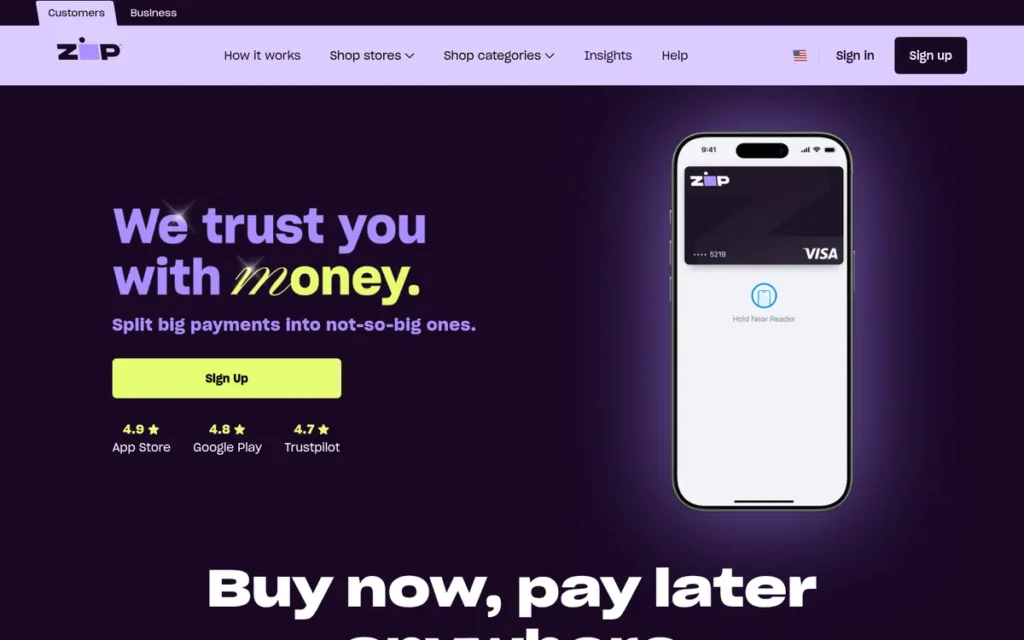
Category: Shop-Anywhere BNPL App, a BNPL app that issues virtual cards so installments work beyond partner checkouts.
At a Glance
- Category: Shop-Anywhere BNPL App
- Best For: Shoppers whose preferred retailers, online or in store, don’t offer Afterpay
- Price Range: Origination fees $0–$140 (Zip’s own examples equal about 34.75%–34.99% APR); late fee $7 or lower state amount; $2 date change after one free change per month (terms checked November 2026)
- Primary Strength: Zip’s virtual card works online and in physical stores through Apple Pay or Google Pay, well beyond partner checkouts.
- Biggest Limitation: Zip’s “no interest” plans can include origination fees that Zip’s own examples equate to about 35% APR.
- One-Line Summary: Zip is tied with Klarna for the widest store reach among the Afterpay alternatives evaluated, but Zip’s origination fees can equal about 35% APR on its own published examples.
- Last Verified: November 2026
Overview
Zip, formerly Quadpay, is a buy now, pay later app that issues a virtual card for use online and in stores through Apple Pay or Google Pay. Zip is for shoppers whose preferred retailers don’t offer Afterpay at checkout. Zip charges origination fees on many plans.
Zip scored 3.03 out of 5, fifth overall. Zip scored 5.0 on store reach, tied with Klarna, but 2.0 on cost, because its own fee examples equal about 35% APR. Zip also lost points for short plans and unverified credit reporting.
Key Features
- Zip issues a virtual card that works online and in stores through Apple Pay or Google Pay.
- Zip offers a physical card to eligible customers for in-store purchases.
- Zip offers Pay in 2, Pay in 4 over six weeks and Pay in 8 over fourteen weeks.
- Zip makes instant approval decisions without a hard credit check.
- Zip allows one free payment-date change per month, and further changes cost $2.
Best For
Zip is best for shoppers who mainly need BNPL at stores without any BNPL checkout and who will check the fee shown before accepting each plan.
Pricing
Zip publishes fee examples showing that its “no interest” plans can carry a finance charge (Zip loan terms of service, terms checked November 2026):
- Zip’s Pay in 4 example shows an $8 fee on a $400 purchase, which Zip states as 34.75% APR.
- Zip’s Pay in 8 example shows an $18.97 fee on a $400 purchase, paid as eight payments of $52.37, which Zip states as 34.99% APR.
- Zip’s origination fees range from $0 to $140.
- Zip’s late fee is $7 or a lower state amount.
- Zip shows an example APR of up to 35.70% on another page, which conflicts with the loan-terms examples (Zip, 2026).
Strengths
- Zip reported U.S. transaction volume of US$6.0 billion, up 41.6%, and 4.25 million active U.S. customers in fiscal 2025 (Zip FY2025 Results, 2025).
- Zip Co is listed on the ASX and reported 6.29 million active customers globally in fiscal 2025. Zip counts an account as active if it had a transaction in the preceding 12 months (Zip FY2025 Results, 2025).
- Zip’s virtual card works online and in stores through Apple Pay or Google Pay, which ties Zip with Klarna for the widest reach among the alternatives evaluated (Zip, 2026).
- Zip makes instant decisions with no hard credit check (Zip for Business, 2026).
- Zip is named by Reddit users as a preferred alternative. One wrote, “Klarna or Zip is the way to go” (u/MissPricless, r/personalfinance, 2026).
This aligns with community sentiment on r/Afterpay:
“Zip is the way to go. You can literally use them anywhere even for your utilities. Affirm, klarna, sezzle not so much. I have never had a zip order denied, up to a $1,800 limit, they are also lenient if you are late and unlike afterpay or klarna which will charge you a late fee and then drop your available balance down to nothing” Posted by u/Pretend_Guidance_574
Takeaway: Zip wins loyal users with near-universal acceptance and consistent approvals, which backs up its top score for store reach.
Limitations
Zip’s wider reach comes at a cost. Zip’s “no interest” plans can carry origination fees of up to $140, and Zip’s own examples put that cost at about 34.75%–34.99% APR. A $7 late fee comes on top.
- Zip’s plans top out at 14 weeks with Pay in 8, so Zip doesn’t serve larger purchases that need monthly terms.
- Zip’s credit-bureau reporting couldn’t be verified from public sources, so shoppers should check Zip’s loan agreement before applying.
- Zip has no verified Trustpilot, App Store, Google Play or BBB ratings, and the dedicated Zip Reddit search found no significant discussion.
- Zip faces reports on a review-summary site of fee confusion, refund problems and account restrictions, though those reports aren’t a representative sample (CheckThat.ai, 2026).
How It Compares With Afterpay
- Zip reaches more stores than Afterpay through its virtual card.
- Zip’s plans often carry an origination fee, while Afterpay’s Pay in 4 has no origination fee.
- Zip’s $7 late fee is close to Afterpay’s maximum of $8.
Verdict
Zip is the best-fit Afterpay alternative for shoppers who mainly need a phone-wallet virtual card that works almost anywhere, online and in person. Because of Zip’s origination fees, its plans are often not fee-free, so shoppers should compare the total repayment shown at checkout.
Zip isn’t built for larger purchases. For those, a monthly lender such as Affirm or PayPal Pay Monthly fits better.
6. Sezzle: Best for Building Credit at Partner Stores
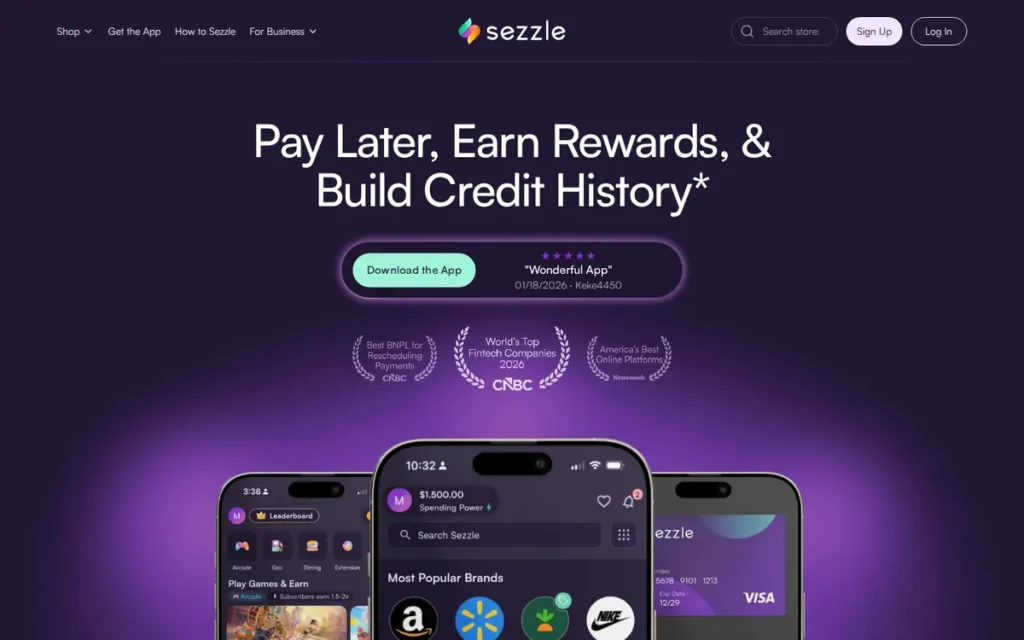
Category: Merchant-Checkout Pay-in-4, short-term installments offered mainly at partner merchants’ checkouts.
At a Glance
- Category: Merchant-Checkout Pay-in-4
- Best For: Frequent shoppers at Sezzle partner merchants who want to build credit and will link a bank account to avoid fees
- Price Range: Service fee may apply (example: $7.49 on $300 = 45.0% APR); late fee up to $16.95; Premium $13.99/month; Anywhere $19.99/month (terms checked November 2026)
- Primary Strength: Sezzle offers pay-in-4 without a hard credit check, plus Sezzle Up, an optional feature that reports eligible payments for credit building.
- Biggest Limitation: Sezzle has the most complex fee schedule of the seven Afterpay alternatives Tested SaaS evaluated, with a late fee of up to $16.95, about double Afterpay’s maximum.
- One-Line Summary: Sezzle is an Afterpay alternative with no hard credit check and an optional credit-building feature, but Sezzle’s fee schedule is the most complex of the seven alternatives Tested SaaS evaluated.
- Last Verified: November 2026
Overview
Sezzle is a Minneapolis-based buy now, pay later provider. It offers four payments over six weeks at participating merchants without a hard credit check, plus an optional credit-building feature called Sezzle Up. Sezzle suits frequent shoppers who are willing to manage its fee schedule.
Sezzle scored 2.83 out of 5, sixth overall. Sezzle scored 4.0 on credit clarity and 4.0 on scale. Its cost score of 1.5 was the lowest in the evaluation, because Sezzle has the most complex consumer fee schedule of the seven.
Key Features
- Sezzle splits purchases into four payments over six weeks without a hard credit check.
- Sezzle Up is an optional feature that reports eligible payment activity to help build credit.
- Sezzle Anywhere provides a virtual card for any U.S. store that accepts Visa, for $19.99 per month.
- Sezzle Premium costs $13.99 per month and unlocks participating brands and perks.
- Sezzle offers monthly installment loans issued through WebBank.
Best For
Sezzle is best for shoppers who buy often at Sezzle partner merchants and want BNPL activity to support their credit file. They should be willing to link a bank account and set up autopay to avoid service and late fees.
Pricing
Sezzle’s own example shows a $7.49 service fee on a $300 purchase, which Sezzle states as 45.0% APR (Sezzle legal fee schedule, terms checked November 2026). Sezzle’s other published consumer fees include:
- Sezzle charges a late fee of up to $16.95, capped at 25% of the order.
- Sezzle charges a failed-payment fee of up to $6.95 and a reschedule fee of up to $7.50.
- Sezzle charges a $1.99 “late saver” fee.
- Sezzle’s G2 vendor description says shoppers can reschedule once for free, but the fee schedule lists a fee of up to $7.50, and the free reschedule couldn’t be verified.
Strengths
- Sezzle reported fiscal 2025 revenue of $450.3 million, up 66.1%, and net income of $133.1 million (Sezzle SEC 8-K exhibit, 2026).
- Sezzle reported 918,000 monthly on-demand and subscription users as of December 2025, and Sezzle is a public-benefit corporation listed on Nasdaq (Sezzle SEC 8-K exhibit, 2026).
- Sezzle’s G2 rating of 4.6/5 from 122 reviews, 94.3% of them 4–5 stars, is the highest of the G2 ratings collected for this review, though most reviewers are merchants (G2, 2026).
- Sezzle approves pay-in-4 without a hard credit check, and one Reddit user reported spending power rising “from $500 up to $2500” over time (u/Salty-Discipline-586, r/Sezzle, 2026).
Limitations
Sezzle’s easy approval comes with complicated fees. Sezzle’s own $7.49-on-$300 example equals 45.0% APR, the highest effective APR in any published example evaluated.
- Sezzle’s late fee of up to $16.95 is more than double Afterpay’s $8 maximum, and Sezzle adds failed-payment, reschedule and subscription fees.
- Sezzle users on Reddit describe a mid-2026 payment-method rule change that led to late fees. Other users say Sezzle’s fees are disclosed at checkout and can be avoided by linking a bank account (u/BOCTOK55, r/Sezzle, 2026).
- Sezzle requires the $19.99/month Sezzle Anywhere subscription for use outside partner merchants.
- Sezzle’s high G2 score mostly reflects merchant reviewers rather than shoppers.
Users on r/Sezzle noted:
“I’ve used a bunch of pay-in-4 apps, and Sezzle is the only one that’s been this aggressive with fees. Other apps actually give you flexibility, like letting you postpone or work through hardship for months without stacking charges. That’s a big difference.” Posted by u/Expgarment
Takeaway: Users say Sezzle stacks failed-payment fees more aggressively than other pay-in-4 apps, so its fee schedule is a real cost for shoppers whose payments don’t clear on time.
How It Compares With Afterpay
- Sezzle and Afterpay both offer pay-in-4 over six weeks.
- Sezzle’s late-fee cap of $16.95 is about twice Afterpay’s $8, and Sezzle may add a service fee.
- Sezzle offers an optional credit-builder, Sezzle Up, that Afterpay doesn’t.
Verdict
Sezzle is a reasonable Afterpay alternative for shoppers who want BNPL to support their credit file through Sezzle Up, provided they link a bank account and avoid its fee triggers. Sezzle’s public Nasdaq listing and reported FY2025 growth document its scale.
Shoppers focused only on cost should compare Sezzle’s checkout total against no-fee options such as PayPal Pay in 4 or Splitit.
7. Perpay: Best for No Hard Credit Check With Steady Payroll
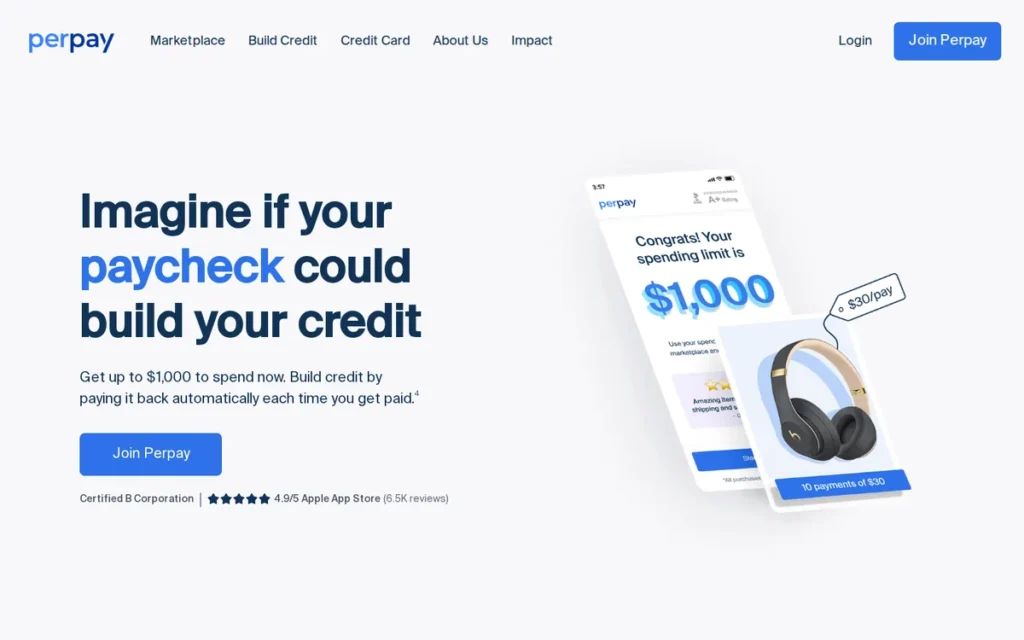
Category: Paycheck-Linked Marketplace, a closed shopping marketplace repaid through automatic paycheck deductions.
At a Glance
- Category: Paycheck-Linked Marketplace
- Best For: Workers with steady payroll direct deposit and thin or damaged credit who want to avoid a hard credit check
- Price Range: Marketplace: $0 interest, $0 late fees; Perpay+ $5/month; Perpay Credit Card 27.99%–29.99% APR with fees (terms checked November 2026)
- Primary Strength: Perpay approves shoppers without a hard credit check and charges no interest or late fees on marketplace purchases.
- Biggest Limitation: Perpay works only inside its own marketplace, where reviewers report prices higher than at other retailers.
- One-Line Summary: Perpay is the Afterpay alternative for shoppers with limited credit and steady payroll income, offering no hard credit check, but Perpay can only be used in its own marketplace.
- Last Verified: November 2026
Overview
Perpay is a shopping marketplace where shoppers repay purchases through automatic deductions from their paycheck’s direct deposit, with no hard credit check. Perpay is for workers with steady payroll income and limited or damaged credit. Perpay offers up to $1,000 in spending power (Perpay, 2026).
Perpay scored 2.35 out of 5, seventh overall. Perpay scored 4.5 on credit clarity, the highest of any provider, and 1.0 on store reach, the lowest. Perpay was founded in 2014 in Philadelphia and is privately held, so it publishes no audited user or volume figures (Wellfound, 2026).
Key Features
- Perpay repays marketplace purchases by splitting the shopper’s paycheck direct deposit.
- Perpay approves shoppers without a hard credit check and charges no interest or late fees on marketplace purchases.
- Perpay offers up to $1,000 in spending power within its marketplace.
- Perpay+ costs $5 per month and reports to Experian, Equifax and TransUnion.
- Perpay offers a separate Perpay Credit Card, issued by Celtic Bank, with its own APR and fees.
Best For
Perpay is best for W-2 workers with steady direct deposit and limited credit history who want a no-hard-check way to buy necessities, and who will first compare Perpay’s marketplace prices with other retailers.
Pricing
Perpay marketplace purchases carry $0 interest and $0 late fees, and Perpay+ costs $5/month (Perpay, terms checked November 2026). The Perpay Credit Card has separate terms (Perpay card agreement, terms checked November 2026):
- The Perpay Credit Card carries 27.99%–29.99% APR and a $9 opening fee.
- The Perpay Credit Card charges a $5.50 or $9/month service fee in year one, then $9/month.
- The Perpay Credit Card charges a late fee of up to $24.
- Perpay’s hidden cost is the marketplace price itself, because reviewers report prices above other retailers (Finder, 2025).
Strengths
- Perpay held ratings of 4.5/5 on Trustpilot (3,074 reviews), 4.5 on the App Store (6,527) and 4.1 on Google Play (6,705), plus a BBB A+ rating, as of December 9, 2025 (Finder, 2025). Perpay’s Trustpilot page showed 4.7/5 when checked in November 2026.
- Perpay approves shoppers without a hard credit check and charges no interest or late fees on marketplace purchases (Perpay, 2026; ConsumerAffairs, 2026).
- Perpay+ reports to all three major bureaus for $5 per month, and Perpay+ reporting can include late payments as well as on-time ones (Perpay, 2026).
- Perpay says Perpay+ customers who started with scores of 550 or below gained 30+ points on average in year one, based on about 50,000 customers. This is a company-reported figure, not a guarantee (Perpay, 2026).
Limitations
Perpay gives up price and choice in exchange for easy approval. Shoppers can buy only within Perpay’s marketplace, and reviewers report prices above other retailers (Finder, 2025).
- Perpay requires payroll direct deposit, which may exclude gig and 1099 workers, and caps spending power at $1,000 (FirstCard, 2026).
- Perpay’s credit card carries 27.99%–29.99% APR, monthly service fees and a late fee of up to $24, the highest late fee in this comparison.
- Perpay’s BBB customer reviews average 3.44/5 from 476 reviews, with complaints about slow support, difficult returns and items or refunds not received (Finder, 2025).
- Perpay’s 6M+ member figure is unverified, and the dedicated Reddit search found no significant Perpay discussion.
How It Compares With Afterpay
- Perpay charges no late fees on marketplace purchases, while Afterpay charges up to $8.
- Perpay skips the hard credit check and bases approval on payroll direct deposit.
- Perpay can’t be used at outside retailers, and store acceptance is the main reason most readers leave Afterpay.
Verdict
Perpay is an Afterpay alternative built for shoppers with limited credit and steady payroll income, because Perpay approves without a hard credit check and charges no marketplace interest or late fees. Perpay+ adds three-bureau reporting for credit building.
Perpay’s marketplace is closed and its prices are reportedly marked up, so shoppers should check each Perpay item’s price elsewhere before buying.
Why Do Shoppers Look for an Afterpay Alternative?
Shoppers mostly look for an Afterpay alternative because Afterpay isn’t accepted at every retailer, its Pay in 4 schedule lasts only six weeks, and late installments cost up to $8 each. Afterpay’s G2 reviewers point to limited acceptance and fees. CNBC Select’s review themes add declined orders and restrictive limits (CNBC Select, 2026).
Afterpay holds a G2 rating of 4.2/5 from 43 reviews, and 83.7% of those reviews give 4 or 5 stars (G2, 2026). Afterpay reviewers praise ease of use but say the repayment schedule can feel “strict at times.”
Afterpay’s top G2 cons each appear in one review:
- Afterpay reviewers cite Slow Performance.
- Afterpay reviewers cite Limited Availability and Limited Acceptance.
- Afterpay reviewers cite Late Fees and High Fees.
Afterpay’s top G2 pros are:
- Afterpay reviewers cite Convenience (2 reviews).
- Afterpay reviewers cite Easy Setup and Ease of Use (1 review each).
- Afterpay reviewers cite the Approval Process and Acceptance (1 review each).
What Are Afterpay’s Current Terms?
Afterpay’s Pay in 4 charges 0% interest and a late fee of up to $8. Its monthly plans run 3 to 24 months at 0%–35.99% APR. Afterpay isn’t ranked in this guide; every alternative is compared against these published terms (Afterpay loan agreement, terms checked November 2026).
- Afterpay charges its Pay in 4 late fee of up to $8 only after a 10-day grace period. The fee is capped at 25% of the order value, and state law may set a lower cap (Afterpay finance-fee loan agreement, terms checked November 2026).
- Afterpay’s monthly plans are issued by First Electronic Bank over 3, 6, 12 or 24 months (Afterpay loan agreement, terms checked November 2026).
- Afterpay belongs to Block. Cash App says Afterpay on Cash App Card, often searched as “Cash App Afterpay,” needs no credit check and isn’t reported to credit agencies (Cash App Help, 2026).
- The no-credit-check policy applies to Afterpay on Cash App Card only, not to all Afterpay products.
- G2 doesn’t list prices for Afterpay (G2, 2026).
How Do Afterpay Alternatives Compare With Afterpay on Key Terms?
Afterpay alternatives differ from Afterpay most on term length, late fees and whether they work outside partner checkouts. Affirm offers the longest term (60 months) and the highest ceiling ($30,000). Four providers charge no late fees of their own. Three products bring BNPL to non-partner stores through virtual cards.
| Provider | Longest Term | Max Purchase | Late Fee | Credit Check | Bureau Reporting | Works Outside Partner Checkout |
|---|---|---|---|---|---|---|
| Afterpay (baseline) | 24 months (monthly plans) | Not verified | Up to $8 after 10-day grace; 25% cap | Not verified (Cash App Card version: none) | Not verified (Cash App Card version: not reported) | Afterpay on Cash App Card (per Cash App); other Afterpay products not verified |
| Affirm | 60 months | $30,000 | $0 | Soft inquiry | Experian and TransUnion | Yes (Affirm Card, virtual cards) |
| PayPal Pay in 4 / Pay Monthly | 24 months (Pay Monthly) | $10,000 (Pay Monthly); Pay in 4 conflicting on provider pages | $0 | Soft check may be required | Pay in 4 reportedly not reported; Pay Monthly not verified | Wherever PayPal is accepted; some in-store use |
| Klarna | Not verified | Not verified | Up to $7 after 10 days unpaid; 25% cap | Soft check (Pay in 4, Pay in 30) | Pay in 4 reportedly not shared with U.S. bureaus; Pay over time reportedly reported to TransUnion and Experian | Yes (one-time virtual card, Klarna Card) |
| Splitit | 3–12 months reported; set by merchant | Limited by available card credit | $0 from Splitit (card issuer terms apply) | None by Splitit | No new loan created | No (integrated merchants only) |
| Zip | 14 weeks (Pay in 8) | Not verified | $7 or lower state amount | No hard check | Not verified | Yes (virtual card via Apple Pay or Google Pay) |
| Sezzle | 6 weeks (Pay in 4); monthly loan terms not verified | Not verified | Up to $16.95; 25% cap | No hard check | Sezzle Up reports eligible activity (optional) | Sezzle Anywhere ($19.99/month) |
| Perpay | Not verified | $1,000 spending power | $0 marketplace; card up to $24 | No hard check | Perpay+ to all three bureaus ($5/month) | No (Perpay marketplace only) |
All terms checked November 2026. “Not verified” means the figure wasn’t found in the research sources; it doesn’t mean the term doesn’t exist.
What Will an Afterpay Alternative Actually Cost?
An Afterpay alternative can cost exactly the purchase price, or as much as the equivalent of a 45% APR, depending on the provider and plan. PayPal Pay in 4, Splitit and Perpay’s marketplace charge no interest or late fees of their own. Zip’s and Sezzle’s own published examples show fees equal to roughly 35%–45% APR.
The figures below are quoted from each provider’s own published examples and terms, not recalculated (terms checked November 2026):
| Provider | Published Example or Term | What It Means for Total Repayment |
|---|---|---|
| PayPal Pay in 4 | 0% APR, $0 late fees | You repay the purchase price |
| Splitit | $0 Splitit interest and fees | You repay the purchase price, plus card interest if you carry a balance |
| Perpay marketplace | $0 interest, $0 late fees | You repay the marketplace price, which reviewers say can be higher than elsewhere |
| Affirm | 0%–36% APR, simple interest, $0 late fees | The total depends on the APR offered; 0% offers are usually merchant-funded |
| Klarna Pay in 4 | Interest-free if paid on time; late fee up to $7 | You repay the purchase price if you pay on time |
| Zip Pay in 4 | $8 fee on $400 = 34.75% APR | $408 total in Zip’s example |
| Zip Pay in 8 | 8 × $52.37 on $400 = 34.99% APR | About $418.97 total in Zip’s example |
| Sezzle | $7.49 service fee on $300 = 45.0% APR | $307.49 total in Sezzle’s example |
| Afterpay (baseline) | 0% on Pay in 4; late fee up to $8 | You repay the purchase price if you pay on time |
Interest-free isn’t the same as fee-free. On their own published examples, “no interest” plans from Zip and Sezzle cost the equivalent of about 35% to 45% APR.
Illustrative arithmetic, not a quoted offer: a $2,000 purchase repaid over 12 months costs $2,000 at 0% APR and about $2,411 at 36% APR with simple interest. That extra $411 equals about 51 of Afterpay’s maximum $8 late fees.
What Is the Difference Between Simple Interest and Deferred Interest?
Simple interest is charged only on the balance as disclosed at checkout. Deferred interest builds up in the background and can be charged back to the purchase date if the balance isn’t cleared by a deadline. Affirm says its loans use simple, non-compounding interest and no deferred interest (Affirm investor materials, 2026).
Several Reddit commenters in a thread about BNPL downsides assumed Affirm uses retroactive deferred interest. Affirm says its model doesn’t work that way (r/personalfinance, 2026).
- A merchant-funded 0% offer means the merchant pays the provider a fee so the shopper pays no interest.
- A simple-interest plan shows its total cost at checkout, so its total repayment is easy to compare across providers.
- A deferred-interest plan can add back interest from the start date if the balance isn’t cleared in time, so shoppers should confirm which model a financing offer uses.
Which Afterpay Alternatives Have No Late Fees in 2026?
Four Afterpay alternatives charge no late fees of their own in 2026: Affirm, PayPal Pay in 4 and Pay Monthly, Splitit, and Perpay’s marketplace. Each policy has a catch. Affirm can charge up to 36% APR, Splitit leaves card-issuer fees in place, and the Perpay Credit Card charges up to $24 (terms checked November 2026).
| Provider | Published Late Fee (terms checked November 2026) |
|---|---|
| Affirm | $0 |
| PayPal Pay in 4 / Pay Monthly | $0 |
| Splitit | $0 from Splitit (card issuer terms apply) |
| Perpay marketplace | $0 |
| Klarna | Up to $7 after 10 days unpaid, capped at 25% of the purchase |
| Zip | $7 or a lower state amount |
| Afterpay (baseline) | Up to $8 after a 10-day grace period, capped at 25% |
| Sezzle | Up to $16.95, capped at 25% of the order |
| Perpay Credit Card | Up to $24 |
A provider with no late fees isn’t automatically cheaper. Affirm has no late fees but can charge up to 36% APR, so the total repayment amount matters more than the late-fee policy.
Is There an Afterpay Alternative With No Credit Check?
Splitit is the only ranked Afterpay alternative that runs no credit check of its own, because it uses a credit card you already own and creates no new loan. Perpay, Sezzle and Zip skip the hard credit check, while Affirm, Klarna and PayPal use a soft check (terms checked November 2026).
- Splitit requires available credit on an existing card, even though Splitit runs no check of its own.
- Perpay bases approval on payroll direct deposit rather than a hard credit check.
- PayPal says its soft check doesn’t affect your credit score.
- Afterpay on Cash App Card needs no credit check, according to Cash App, but that applies to that product only (Cash App Help, 2026).
- No provider evaluated advertises guaranteed approval. Even no-check and no-hard-check providers review eligibility factors such as income, card limit or payment history.
- Each provider decides approval separately, and Affirm decides per purchase. A decline from one provider doesn’t necessarily mean a decline from another, so check the soft-check terms before you apply again.
How Do Afterpay Alternatives Affect Your Credit?
A credit check decides whether you’re approved. Credit reporting decides whether your payments follow you. Affirm reports loans to Experian and TransUnion, Perpay+ reports to all three bureaus, and Sezzle Up reports eligible activity. PayPal Pay in 4 and Klarna Pay in 4 reportedly aren’t reported, and Zip’s practice isn’t verified.
| Provider | Check at Approval | Reporting Afterward | Credit-Building Option |
|---|---|---|---|
| Affirm | Soft inquiry | Experian and TransUnion; Pay in 4 to Experian since April 1, 2025 | Built in |
| PayPal Pay in 4 | Soft check may be required | Reportedly not reported | None documented |
| Klarna | Soft check | Pay in 4 reportedly not shared; Pay over time reportedly reported to TransUnion and Experian | None documented |
| Splitit | None | No new loan created | None |
| Zip | No hard check | Not verified | None documented |
| Sezzle | No hard check | Sezzle Up reports eligible activity | Sezzle Up (optional) |
| Perpay | No hard check | Perpay+ reports to Experian, Equifax and TransUnion | Perpay+ ($5/month) |
Recent changes in credit scoring and regulation make reporting practices more important:
- FICO launched FICO Score 10 BNPL and FICO Score 10 T BNPL in 2025, though BNPL data wasn’t yet counted in widely used scores when the reviewed sources were written (CBS News, 2025; Congressional Research Service, 2025).
- The CFPB withdrew its 2024 BNPL interpretive rule in May 2025 (CFPB, 2025).
- New York enacted a BNPL law in May 2025, though its details weren’t verified for this review (APBusinessExamPrep, 2025).
- The CFPB warns that missed BNPL payments can lead to fees, collections or credit consequences (CFPB BNPL Report, 2025).
How Can Shoppers Avoid Overspending With Buy Now, Pay Later?
To avoid overspending with BNPL, first ask whether you could afford the purchase without a plan. Then use autopay and limit how many plans run at once. Late payments are common: 41% of BNPL users reported a late payment in the past year (LendingTree via Business Insider, 2025), and a later survey reported by DigitalApplied put the figure at 47% (DigitalApplied, 2026).
- The top comment in a Reddit thread on BNPL downsides warned: “Most people will see their bank account still full and end up spending way more than they budgeted” (u/Superben14, r/personalfinance, 2026).
- Reddit users repeatedly say they first ask “can I afford it without the plan” and rely on autopay to stay on schedule (r/personalfinance, 2026).
- Shoppers who run plans with several providers should track every due date in one calendar so payments don’t overlap.
As one user on r/CreditCards described:
“But I think its best to fully avoid buy now pay later, it is incredibly easy to stack it up beyond what you thought you’d owe, its easier to spend more, and if you miss a payment the fees come down hard. Its better to save that money every 2 weeks and buy it in full as you did” Posted by u/Atomosic
Takeaway: The biggest risk with buy now, pay later is how people use it: easy approvals make it simple to stack plans past a budget and then pay steep fees after a missed payment.
When Does It Make Sense to Stay With Afterpay?
Staying with Afterpay makes sense when three things are true: Afterpay is accepted where you shop, you reliably pay on time so its late fee never applies, and your purchase fits a six-week schedule. In that case, switching may gain you little, because Afterpay’s Pay in 4 already charges 0% interest.
- Afterpay remains a reasonable choice for small purchases at retailers that offer it at checkout.
- Afterpay’s monthly plans (3 to 24 months, 0%–35.99% APR) may cover mid-size purchases, although Affirm offers longer terms.
- Some Reddit users stay loyal to Afterpay. One wrote: “I recently closed my Sezzle account and exclusively use Afterpay. No complaints!” (u/glittereddaisy13, r/Sezzle, 2026).
What Red Flags Should I Watch For When Evaluating Afterpay Alternatives?
The biggest red flag when evaluating an Afterpay alternative is an “interest-free” plan that still carries fees. The seven red flags below hold every provider to the same standard. They draw on published fee schedules and reported user experiences, so you can test any provider before linking a card or bank account.
Red Flag #1: Interest-Free but Not Fee-Free An “interest-free” plan can still carry fees equal to a high APR. Sezzle’s $7.49 fee on a $300 purchase looks small, but the plan lasts only six weeks, so Sezzle states it equals 45.0% APR. Zip’s examples equal about 35% APR (Sezzle and Zip, terms checked November 2026).
Red Flag #2: Late Fees Above Afterpay’s $8 Some alternatives charge more than Afterpay for a missed payment. Sezzle’s late fee reaches $16.95 and the Perpay Credit Card’s reaches $24. Shoppers who sometimes pay late should check every provider’s late fee before switching (provider fee schedules, terms checked November 2026).
Red Flag #3: Limits That Drop Without Explanation Spending limits can fall suddenly and without explanation. One Reddit user reported a Sezzle limit dropping from $1,500 to $0, and PayPal shoppers report low or changing approvals. Don’t count on a spending limit staying the same from one purchase to the next (u/Few_Razzmatazz5493, r/personalfinance, 2026; LegalClarity, 2026).
Red Flag #4: Payment-Method Rule Changes That Trigger Late Fees A change in which cards or accounts a provider accepts can cause a missed payment. Reddit users describe a mid-2026 Sezzle rule change announced shortly before a due date. Another user notes that PayPal’s pay-in-3 option requires a debit card while Pay in 4 accepts credit cards (r/Sezzle, 2026; u/BigRedHD, r/Sezzle, 2026).
Red Flag #5: Refunds Held or Issued as Account Credit Refund handling varies, and slow refunds are a common complaint across the category. Klarna, Sezzle, Perpay and Zip all face reports of slow refunds or refunds issued as account credit, so check the refund policy before buying returnable items (PaymentReview, 2026; r/Sezzle, 2026; Finder, 2025; CheckThat.ai, 2026).
Red Flag #6: Fees to Reschedule, Pay Early or Load a Balance Changing a plan or paying ahead isn’t always cheap. Zip charges $2 for a payment-date change after one free change per month, and Sezzle lists a reschedule fee of up to $7.50 (provider fee schedules, terms checked November 2026). By contrast, Reddit users praise Klarna’s free early payoff (r/Sezzle, 2026).
Red Flag #7: Stacking Several Plans and Due Dates Every extra BNPL plan adds due dates and raises the risk of a missed payment. Recent surveys found that 41% to 47% of BNPL users reported a late payment, so shoppers should track every active plan across providers in one calendar (LendingTree, 2025; DigitalApplied, 2026).
What Questions Should I Ask Before Choosing an Afterpay Alternative?
The most important question to ask before choosing an Afterpay alternative is how much you will repay in total, because that one number captures every fee. The seven questions below cover the other costs and risks, and each explains what a good answer from any provider looks like.
Question #1: What is the total amount I will repay, including all fees? A clear provider shows the total repayment amount at checkout, not just the installment size. Look for both the dollar total and the equivalent APR, as Zip and Sezzle publish in their own examples. Compare that total with the purchase price before you accept any plan.
Question #2: What happens, and what does it cost, if I miss a payment? A good answer names the late-fee amount, the cap and any grace period. Compare it with Afterpay’s terms: up to $8 after a 10-day grace period, capped at 25% of the order. Klarna’s timing is similar, with up to $7 for an installment still unpaid 10 days after its due date.
Question #3: Is this a soft check, no hard check, or no check at all? Providers use different approval checks, and the wording matters. Splitit runs no check of its own. Perpay, Sezzle and Zip skip the hard check, and Affirm, Klarna and PayPal use a soft check. If a provider’s page doesn’t say which type applies, ask the provider directly.
Question #4: Does this provider report my payments to credit bureaus, and which ones? A transparent provider names the bureaus it reports to. Affirm names Experian and TransUnion, and Perpay+ names all three bureaus. Klarna Pay in 4 and PayPal Pay in 4 reportedly aren’t reported, and Zip’s U.S. reporting couldn’t be confirmed from public sources.
Question #5: Can I use it at the store where I want to shop, online and in person? Check whether the provider works only at partner checkouts or offers a virtual card. Zip and Klarna offer virtual cards, and Sezzle Anywhere costs $19.99/month. Splitit and Perpay have the narrowest reach. In-store use usually depends on a virtual card or phone wallet.
Question #6: Can I pay early for free? A shopper-friendly provider lets you pay off a plan early at no cost. Affirm charges no prepayment fees. Reddit users praise Klarna’s free early payoff and contrast it with a $4.99 charge elsewhere (Affirm investor materials, 2026; u/CandyDisastrous7182, r/Sezzle, 2026).
Question #7: Could I afford this purchase without the plan? If the answer is no, any BNPL plan carries a real risk of late fees, collections or credit consequences, as the CFPB warns (CFPB BNPL Report, 2025). Reddit users consistently name this as the first test before using any provider (r/personalfinance, 2026).
How Did We Rank These Afterpay Alternatives?
Tested SaaS ranked seven Afterpay alternatives on six weighted criteria, each scored from 1 to 5. Scores are based on the providers’ published fee schedules and loan terms, their public filings and dated reviews. True cost carries the most weight at 25%. Terms were checked in November 2026, and Afterpay’s published terms serve as the unranked baseline.
The six criteria and why each matters:
- True Cost and Fee Transparency (25%): Shoppers can’t always tell which plans are truly interest-free. This criterion weighs late fees and effective APRs, and conflicting first-party figures lower the score.
- Purchase Size and Repayment Flexibility (20%): Afterpay’s six-week Pay in 4 doesn’t suit large purchases, so this criterion weighs maximum purchase amount, plan types and longest term.
- Store Acceptance and Reach (20%): Limited acceptance is the most common reason to leave Afterpay, so this criterion weighs virtual cards, in-store use and named merchant partnerships.
- Credit Check and Credit-Impact Clarity (15%): Shoppers often confuse approval checks with credit reporting, so this criterion weighs both, and unconfirmed practices lower the score.
- Post-Checkout Experience and User Sentiment (10%): Refunds, limit cuts and support quality shape the experience after purchase. A provider without a verified consumer rating can score no higher than 3.0.
- Verified Scale and Stability (10%): Documented scale makes an abrupt shutdown less likely, and Apple Pay Later’s discontinuation shows that shutdowns do happen.
| Rank | Provider | C1 Cost | C2 Size | C3 Reach | C4 Credit | C5 Sentiment | C6 Scale | Weighted Score | Highest-Scoring Criterion | Lowest-Scoring Criterion |
|---|---|---|---|---|---|---|---|---|---|---|
| 1 | Affirm | 4.0 | 5.0 | 4.0 | 4.0 | 3.0 | 5.0 | 4.20 | Size 5.0 / Scale 5.0 | Sentiment 3.0 |
| 2 | PayPal Pay in 4 / Pay Monthly | 4.5 | 4.0 | 4.0 | 3.0 | 3.0 | 5.0 | 3.98 | Scale 5.0 | Credit 3.0 / Sentiment 3.0 |
| 3 | Klarna | 3.0 | 4.0 | 5.0 | 2.5 | 3.0 | 5.0 | 3.73 | Reach 5.0 / Scale 5.0 | Credit 2.5 |
| 4 | Splitit | 4.5 | 2.5 | 1.5 | 4.0 | 3.5 | 2.5 | 3.13 | Cost 4.5 | Reach 1.5 |
| 5 | Zip | 2.0 | 2.5 | 5.0 | 2.5 | 2.5 | 4.0 | 3.03 | Reach 5.0 | Cost 2.0 |
| 6 | Sezzle | 1.5 | 3.0 | 3.0 | 4.0 | 2.5 | 4.0 | 2.83 | Credit 4.0 / Scale 4.0 | Cost 1.5 |
| 7 | Perpay | 2.5 | 1.5 | 1.0 | 4.5 | 3.5 | 2.0 | 2.35 | Credit 4.5 | Reach 1.0 |
Weighted score = (C1 × 0.25) + (C2 × 0.20) + (C3 × 0.20) + (C4 × 0.15) + (C5 × 0.10) + (C6 × 0.10).
How the scoring rules were applied:
- PayPal’s sentiment score is capped at 3.0 because Pay in 4 has no verified consumer rating; PayPal’s G2 entry covers its merchant product.
- PayPal’s cost score is 4.5 rather than 5.0 because PayPal’s own pages publish conflicting purchase ranges and APR floors.
- Affirm and PayPal tie at 4.0 on reach because both work beyond a single merchant checkout: PayPal through its wallet and in-store app, Affirm through the Affirm Card.
- Klarna and Zip tie at 5.0 on reach because both issue virtual cards for non-partner stores.
- Klarna’s credit score stays at 2.5 because Klarna’s reporting policy is confirmed only by secondary sources.
- Affirm and PayPal are close (4.20 vs. 3.98), so shoppers who only need pay-in-4 should consider PayPal first.
- G2 ratings mostly come from merchants, so they support the comparison but don’t drive the ranking.
- Approval, limits and APR vary by shopper, so the scores describe published terms, not individual outcomes.
- Reddit coverage was uneven. Dedicated searches for Klarna, Zip, Splitit and Perpay found no significant discussion, and PayPal’s dedicated search result couldn’t be read.
- Undated web pages and Reddit threads are cited with the year they were checked.
The following first-party figures conflict; in each case, the checkout disclosure is the binding term:
- PayPal shows Pay in 4 ranges of $30–$1,500 and $10–$2,000 on different pages.
- PayPal shows Pay Monthly APR as 9.99%–35.99% and as 0%–35.99% on the same page.
- Zip shows APR examples of 34.75%–34.99% in its loan terms and up to 35.70% on another page.
- Sezzle’s G2 vendor description mentions one free reschedule, while Sezzle’s fee schedule lists a reschedule fee of up to $7.50.
Three products were excluded from the ranking:
- Apple Pay Later was excluded because Apple discontinued it, and Apple Pay now routes shoppers to other lenders’ offers (Apple Support, 2026).
- Shop Pay Installments was excluded because it is powered by Affirm and wasn’t separately covered by this research.
- Afterpay was excluded because it is the baseline readers are comparing against.
Tested SaaS has no affiliate relationships with any company listed. Rankings are determined entirely by research data and objective evaluation criteria.
What Do Shoppers Ask Most About Afterpay Alternatives?
Shoppers most often ask which Afterpay alternative works at the most stores, what happens after a missed payment, and how Tested SaaS sets its rankings. The short answers: Zip and Klarna reach the most stores, missed payments can bring fees or collections, and rankings follow six published weighted criteria.
Which Afterpay alternative works at the most stores?
Zip and Klarna tie for the widest store reach, because both issue virtual cards that extend pay-in-4 beyond partner checkouts. Zip’s card works through Apple Pay or Google Pay, while Klarna offers a one-time card in its app. The trade-offs are Zip’s origination fees and Klarna’s late fees of up to $7.
What happens if I miss a buy now, pay later payment?
A missed BNPL payment can lead to a late fee, collections or credit consequences, depending on the provider (CFPB BNPL Report, 2025). Late fees range from $0 at Affirm and PayPal to $16.95 at Sezzle. Afterpay charges up to $8 after a 10-day grace period (terms checked November 2026).
How does Tested SaaS determine rankings?
Tested SaaS scores each Afterpay alternative from 1 to 5 on six weighted criteria, using published fee schedules, loan terms and dated evidence. Afterpay is the unranked baseline. The scores describe published terms, not any individual shopper’s approval. The six weights are:
- True cost and fee transparency: 25%
- Purchase size and repayment flexibility: 20%
- Store acceptance and reach: 20%
- Credit check and credit-impact clarity: 15%
- Post-checkout experience and user sentiment: 10%
- Verified scale and stability: 10%
What Do Key Buy Now, Pay Later Terms Mean?
Shoppers comparing buy now, pay later providers run into about a dozen recurring terms covering cost, credit and how a plan is funded. Knowing the difference between an APR and an origination fee, or between a soft and a hard credit check, makes checkout disclosures easier to read and total costs easier to compare.
Pay in 4: A short-term plan that splits a purchase into four payments, usually every two weeks over about six weeks. It is often interest-free, but some providers add service or origination fees.
APR (Annual Percentage Rate): The yearly cost of borrowing, expressed as a percentage that includes interest and some fees. Comparing APRs shows the true cost of plans that look similar.
Origination fee: A one-time charge for creating a loan, often added to “no interest” plans. Expressed as an APR, it can make a short plan as expensive as a high-rate credit card.
Simple interest: Interest calculated only on the amount borrowed, without compounding. It makes the total repayment predictable and easy to compare at checkout.
Deferred interest: A promotional model in which interest builds up in the background and can be charged back to the start date if the balance isn’t paid in full by a deadline. Buyers should confirm whether a financing offer uses this model.
Merchant-funded 0% offer: A promotion in which the retailer pays the lender a fee so the shopper pays no interest. It explains why 0% offers appear at some stores and not others.
Soft credit check: A credit review that doesn’t usually affect your credit score. Many BNPL providers use one to decide approval and spending limits.
Hard credit inquiry: A full credit check that can temporarily lower a credit score. “No hard check” plans avoid it but may still review other data.
Credit bureau reporting: When a lender sends payment activity to credit bureaus after approval. Reporting can help build credit through on-time payments or hurt it through missed ones.
Virtual card: A digital card number created in an app for use online or through a phone wallet. It lets installment plans work at stores without a BNPL checkout.
Late fee cap: A limit on how much a provider can charge for a missed payment, often set as a percentage of the order. Buyers should compare both the dollar amount and the cap.
Authorization hold: A temporary reservation of available credit on a card for the full purchase price. It lowers your available card limit until the installments are paid.
Which Afterpay Alternative Is Right for You?
Key Insights
The right Afterpay alternative depends on why you’re leaving Afterpay. Affirm fits larger purchases, PayPal Pay in 4 fits no-late-fee short-term plans, and Klarna or Zip fit stores without Afterpay. Splitit, Perpay and Sezzle suit specific credit situations. In every case, compare the total repayment amount shown at checkout.
- Affirm is the best fit for larger purchases, with loans up to $30,000 over as long as 60 months and no late fees.
- PayPal Pay in 4 is the most predictable short-term choice because it charges no interest and no late fees on eligible purchases.
- Klarna suits shoppers who want several plan types and a one-time virtual card for stores without a Klarna checkout.
- Zip suits shoppers who want a phone-wallet virtual card, but Zip’s own examples show origination fees equal to about 35% APR.
- Splitit is the only ranked alternative that runs no credit check of its own, provided the shopper holds a credit card with enough available credit.
- Sezzle suits credit building through Sezzle Up if the shopper links a bank account and avoids Sezzle’s fee triggers.
- Perpay suits shoppers with thin credit and steady payroll direct deposit who compare Perpay’s marketplace prices first.
- Afterpay remains a sound choice when it’s accepted where you shop and you pay on time, because Afterpay’s Pay in 4 then costs only the purchase price.
If you need to finance a large purchase, start with Affirm and compare its total repayment against PayPal Pay Monthly. If your store doesn’t accept Afterpay, try Klarna’s one-time card or Zip’s virtual card, and check the fee shown before accepting either plan.
BNPL terms change often, so the disclosure at checkout is the binding term. Read our full methodology and see our other independent reviews at Tested SaaS before your next purchase. We update this guide quarterly. Last updated: November 2026.